
Revolutionizing Library Services: The Power of UHF Self-Service Borrowing and Returning Machines
In the digital age, libraries are undergoing a significant transformation, embracing technology to enhance operational efficiency and improve user experience. Among the most impactful innovations is the Ultra-High Frequency (UHF) self-service borrowing and returning machine, a cornerstone of the modern “smart library.” This advanced system is fundamentally changing how libraries manage their circulation processes, shifting from traditional manual check-ins and check-outs to streamlined self-service operations. By empowering patrons with greater autonomy and simplifying workflows for library staff, these machines are simultaneously enhancing service quality and boosting circulation rates. This article explores the comprehensive capabilities, features, and benefits of UHF self-service borrowing and returning machines, highlighting why they have become an indispensable component of contemporary library management.

The Core Functionality: How UHF Self-Service Machines Transform Library Circulation
At its heart, the UHF self-service borrowing and returning machine automates the entire book circulation process. It serves as an interactive terminal that allows patrons to independently manage their library transactions without direct staff intervention.
- From Manual to Automated: The primary transformation is the replacement of librarian-mediated borrowing and returning with a self-service model. Patrons can now perform these tasks themselves, at their convenience, reducing queues at circulation desks and freeing library staff to focus on more complex patron inquiries, collection development, and community programs.
- RFID Technology Integration: These machines are specifically designed to work with books tagged with UHF RFID (Radio Frequency Identification) labels. Unlike traditional barcodes that require line-of-sight scanning, RFID technology allows the machine to scan, identify, and process multiple books simultaneously, simply by placing them within the machine’s detection field. This technology is not affected by the book’s orientation or the presence of magnetic security strips.
- Comprehensive Self-Service Capabilities: A robust UHF self-service system provides a full suite of circulation functions accessible through an intuitive interface:
- Borrowing: Patrons can check out multiple books at once by placing them on the machine’s scanning area and identifying themselves via a library card, barcode, or integrated campus/city card.
- Returning: The process is equally simple for returns. Books are placed in the designated area, scanned instantly, and then deposited into an integrated return bin. The system immediately updates the patron’s account and the library’s catalog.
- Renewal: Patrons can quickly renew eligible items without needing to visit the circulation desk or log in to a separate online portal, provided there are no holds on the items.
- Overdue Inquiry: The machine provides immediate access to a patron’s account status, clearly displaying any overdue items and associated fines, allowing for transparency and prompt resolution.
This comprehensive automation significantly accelerates the circulation process, reducing transaction times from minutes to seconds and dramatically improving overall library efficiency.

Key Features That Define Advanced UHF Self-Service Systems
The effectiveness of these machines lies in their sophisticated features, designed for security, user-friendliness, and seamless integration with existing library infrastructure. Here are the defining characteristics:
- Multi-Function Self-Service Terminal: As highlighted, the core function encompasses borrowing, returning, renewal, and overdue status checking, all consolidated into a single, user-friendly device.
- Intuitive User Interface with Multimodal Guidance: The operation interface is designed for simplicity and accessibility. It features clear, on-screen text instructions complemented by synchronized voice prompts, guiding users step-by-step through each transaction. This multimodal approach ensures the system is intuitive, straightforward, and quick to operate for patrons of all ages and technical abilities.
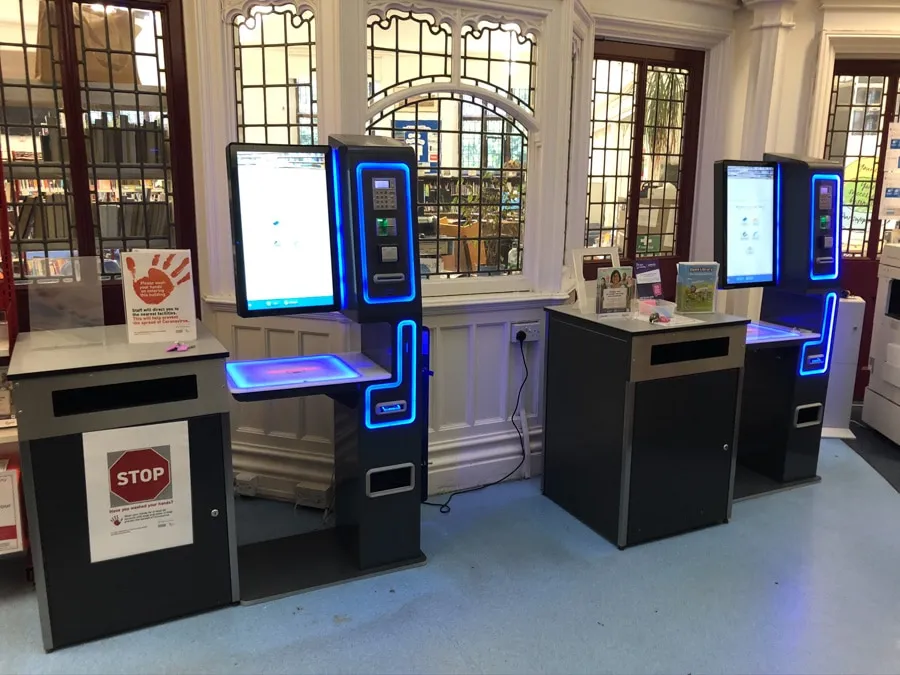
- Integrated Return Book Bin: For convenience and efficiency, the machine incorporates a built-in return bin. After books are scanned and identified as returned, patrons can easily deposit them directly into this secure container within the kiosk, simplifying the drop-off process and keeping the area tidy.
- Advanced Multi-Book Detection Technology: Utilizing sophisticated video-based multi-book detection technology, the system can accurately identify and process several books at once, regardless of their position or the presence of traditional magnetic security strips. This technology is crucial for preventing errors like “one code, multiple borrows,” ensuring each book is individually accounted for in the transaction.
- Anti-Tampering with Infrared Sensors: To enhance security during the borrowing process, the machine is equipped with two or more infrared sensors. These sensors detect if a book is removed or swapped during the transaction, preventing potential fraud or errors and ensuring only the scanned and identified books are borrowed.
- Video Management with Information Overlay: For security and dispute resolution, the system includes a video management function. It can capture images or short video clips of patrons during the borrowing and returning process. Critically, it overlays key transaction data—such as the patron’s ID number and the exact timestamp—onto the image, creating an indisputable record for auditing purposes if needed.
- Standardized Data Interface for Seamless Integration: The system employs standardized data interfaces (e.g., SIP2, NCIP) that allow it to connect effortlessly with most mainstream Library Management Systems (LMS). This ensures that all transactions processed at the kiosk are instantly and accurately reflected in the library’s central database.
- Multiple Identification Methods Supported: Catering to diverse library setups, the system supports various patron identification methods. This includes traditional library barcodes, RFID cards, campus/city smart cards (“one-card” solutions), and sometimes even biometric data, providing flexibility for both the library and its users.
- Remote Exception Alerting: To ensure continuous operation and prompt issue resolution, the system features remote exception alerting. In case of malfunctions, paper shortages, or other technical issues, the machine can automatically notify library administrators via SMS, email, or other messaging platforms, enabling swift maintenance.
- Remote Device Management: Library IT staff can remotely monitor, control, and manage the kiosk’s operational status. This includes checking usage statistics, updating software, troubleshooting problems, and configuring settings without needing physical access to the machine, significantly reducing downtime and maintenance costs.
- Web-Based Reporting and Analytics: The system provides powerful web-based tools for querying and analyzing transaction data. Librarians can generate detailed reports and visual charts on circulation trends, peak usage times, popular titles, and machine performance, aiding in data-driven decision-making for resource allocation and service improvement.
- Real-Time Receipt Printing: For patrons who require a physical record of their transactions, the machine includes a thermal printer that generates real-time receipts for borrowing and returning activities. These receipts typically list the items processed, due dates, and any relevant messages.
The Tangible Benefits: Enhancing Libraries and Empowering Patrons
The implementation of UHF self-service borrowing and returning machines yields significant advantages for both the library institution and its patrons.
For Libraries:
- Dramatically Improved Operational Efficiency: By automating the most frequent and time-consuming tasks (check-ins and check-outs), libraries can process a much higher volume of transactions with the same or fewer staff members. Circulation desks are no longer bottlenecks during peak hours.
- Optimized Staff Allocation: Librarians and circulation staff are freed from repetitive manual tasks. They can be redeployed to more value-added roles such as reference services, reader’s advisory, program coordination, technology assistance, and community outreach, directly enhancing the quality of service.
- Increased Circulation Rates: The speed and convenience of self-service encourage patrons to borrow more items, more often. Reduced wait times and 24/7 return capabilities (if the kiosk is placed in an accessible location) contribute to higher overall circulation figures.
- Enhanced Accuracy and Reduced Errors: Automated RFID scanning and system processing minimize human errors associated with manual data entry, such as mis-scanning barcodes or incorrectly applying due dates. This leads to more accurate patron accounts and inventory records.
- Improved Security and Accountability: Features like multi-book detection, infrared anti-tampering sensors, and video recording with data overlay provide robust security measures. They deter theft, prevent processing errors, and create clear audit trails for resolving disputes.
- Valuable Data Insights: The reporting and analytics capabilities provide libraries with actionable data. Understanding circulation patterns, peak times, and popular collections helps in making informed decisions about collection development, staffing schedules, and resource allocation.
- Space Optimization: Self-service kiosks typically have a smaller footprint than traditional circulation desks, allowing libraries to reclaim valuable floor space for additional seating, shelving, collaborative areas, or program spaces.
- Extended Service Hours: While not always staffed, self-service return kiosks (and sometimes borrowing kiosks in secure lobbies) can offer service outside of regular library hours, increasing accessibility for patrons.
For Patrons:
- Unparalleled Convenience and Speed: Patrons can check out or return multiple books in seconds, avoiding long lines at the circulation desk. The self-service model puts them in control of their library transactions.
- Privacy and Autonomy: Many patrons prefer the privacy of handling their own borrowing and returning activities without potential judgment or interaction. The self-service model caters to this preference.
- Extended Access: As mentioned, the ability to return books (and sometimes borrow them) outside of standard operating hours provides greater flexibility for patrons with busy schedules.
- Empowerment and Ease of Use: The intuitive, guided interface with voice and text prompts makes the system accessible to virtually all patrons, including those who may be less tech-savvy. The process is straightforward and empowering.
- Immediate Account Information: Patrons can instantly check their account status, see due dates, and identify any overdue items or fines directly at the kiosk, promoting transparency and timely management of their library accounts.
- Reduced Friction: The overall library experience becomes smoother and more enjoyable when routine tasks are simplified. This positive interaction encourages more frequent library visits and greater engagement with library resources.

A Cornerstone of the Smart Library Ecosystem
UHF self-service borrowing and returning machines are not standalone devices; they are integral components of the broader “smart library” ecosystem. A smart library leverages technology to create a more efficient, accessible, and user-centric environment. The self-service kiosk acts as a critical touchpoint in this ecosystem.
- Integration with RFID Infrastructure: These machines work seamlessly with other RFID-enabled library technologies, such as security gates (which can be set to alarm if unprocessed items pass through), automated sorting systems (which sort returned books from the kiosk bin by category), and staff handheld inventory readers (for fast shelf management and stocktaking).
- Data Synergy: The transaction data collected by the kiosks feeds into the library’s central management system and analytics platforms. This data, combined with information from other sources (like online catalog usage, program attendance), provides a holistic view of library operations and patron behavior.
- Enhancing the User Journey: The kiosk is a key element in the patron’s journey through the library. It simplifies the entry and exit points of their interaction (borrowing and returning), allowing them to spend more time on the core activities of browsing, reading, studying, and participating in library programs.
- Enabling New Service Models: The efficiency gains from self-service circulation enable libraries to experiment with and implement new service models, such as extended hours, satellite locations with minimal staffing, or focus on specialized services within the main library.
By serving as an automated, efficient, and data-rich interface between the patron and the library’s collection, the UHF self-service machine is foundational to creating a modern, responsive, and intelligent library service.

Conclusion: Embracing the Future of Library Circulation
The Ultra-High Frequency (UHF) self-service borrowing and returning machine represents a paradigm shift in library operations, moving far beyond a simple convenience to become a strategic necessity. By automating the core circulation process, these machines deliver a powerful combination of enhanced operational efficiency and significantly improved patron service. Libraries that adopt this technology benefit from streamlined workflows, optimized staff utilization, increased circulation rates, and valuable data-driven insights. Patrons, in turn, enjoy unprecedented speed, convenience, privacy, and control over their library interactions.
The sophisticated features embedded in modern systems—intuitive interfaces, multi-book RFID detection, robust security measures, seamless LMS integration, and comprehensive remote management—ensure that these machines are not just effective but also secure, reliable, and adaptable to the unique needs of each library. They are a testament to how technology can be harnessed to remove friction from essential services, allowing human expertise to be directed where it matters most: fostering community, supporting learning, and curating knowledge.
As libraries continue to evolve in the digital age, the UHF self-service borrowing and returning machine stands as a cornerstone of the smart library vision. It is an investment in the future, empowering libraries to meet the growing expectations of their patrons while maximizing the impact of their resources and staff. For any library aiming to modernize its services, boost circulation, and create a more welcoming and efficient environment, implementing a UHF self-service system is a decisive step toward achieving those goals.
 English
  Spanish
  French
  German
  Portuguese
  Italian
  Russian
  Dutch
Dutch  Norwegian
  Arabic

