
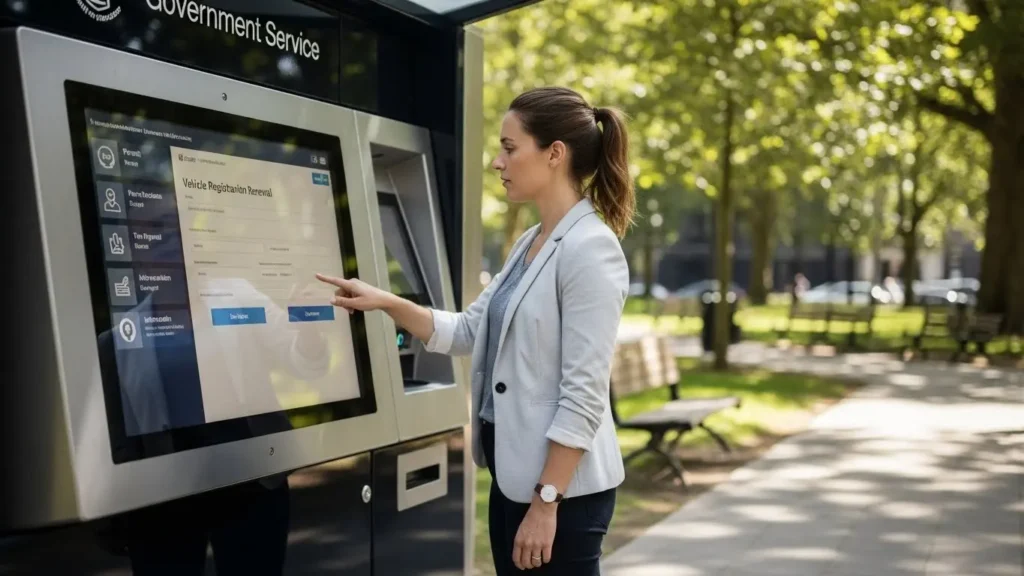
Introduction: Government Services Are Moving Outdoors
Across the world, cities are discovering that public services don’t always need to stay inside government buildings. More and more services are being offered outdoors through modern self-service kiosks that citizens can access at any time of the day. Whether people need to pay a fine, renew a license, complete a quick application, or simply check public information, outdoor government kiosks are becoming one of the most visible and convenient parts of urban digital transformation.
Traditional government offices still play an important role, but they often suffer from limited operating hours, long queues, and heavy workloads. Outdoor kiosks help cities reduce these challenges while giving citizens a faster and more flexible experience. As smart city projects continue expanding globally, outdoor kiosks have become one of the easiest and most effective ways for governments to modernize their services.
This article explains why outdoor government kiosks are growing so quickly, what benefits cities gain, the most common uses, and how outdoor kiosks shape the future of public service delivery.
Why Outdoor Government Service Kiosks Are Becoming the New Standard
One of the simplest reasons outdoor kiosks are popular is convenience. Government offices usually operate during standard business hours, when most people are also working. This makes it difficult for citizens to visit government departments unless they take time off or endure long waiting times. Outdoor kiosks solve this problem by offering 24/7 access. People can complete necessary tasks early in the morning, late at night, on weekends, or during public holidays. This flexibility is especially helpful for busy workers, parents, and people with disabilities who prefer not to wait inside crowded office lobbies.
Outdoor kiosks also relieve pressure on government buildings. During peak seasons such as tax deadlines, benefit renewal windows, or license registration periods, city offices can become incredibly crowded. By moving simple and repetitive tasks outside, governments can focus their staff on more complex cases while citizens complete routine services independently. This creates a smoother workflow and significantly improves overall service quality.
Another reason outdoor kiosks are spreading is the global trend toward smart city development. Cities are integrating digital infrastructure into public spaces, and outdoor kiosks fit naturally into this ecosystem. They can connect with city databases, transportation systems, payment platforms, police networks, and public information systems. This makes outdoor kiosks not just service machines, but part of a larger digital service network that cities rely on for modern operations.
Outdoor locations also make kiosks more accessible. Instead of hiding services deep inside government buildings, cities place kiosks in high-traffic public areas such as metro stations, hospitals, community centers, business districts, and public plazas. This visibility encourages more citizens to use them and normalizes digital government services.
Finally, outdoor kiosks align well with the post-pandemic shift toward contactless and self-service solutions. Many people now prefer independent, low-contact service experiences rather than crowded indoor counters, and outdoor kiosks give them exactly that.
Popular Use Cases for Outdoor Government Kiosks
While different cities use outdoor kiosks in unique ways, certain applications appear everywhere because they solve universal public service challenges. The most common one is payment. Outdoor kiosks allow citizens to pay utility bills, municipal fees, parking fines, traffic citations, permit fees, and other charges without needing to speak to a clerk. The kiosks usually support multiple payment methods including credit cards, digital wallets, QR codes, and sometimes even cash.
Document and ID-related services are also increasingly common. Citizens can renew ID cards, scan documents, print certificates, check the status of applications, or update their information. This significantly reduces the workload of administrative offices, especially departments like city halls or immigration services.
Cities also use outdoor kiosks for queue management. Instead of entering a crowded building, citizens can register their place in line outside. The kiosk assigns a number and sends alerts when the citizen’s turn is approaching. This avoids people waiting inside small spaces and makes the service process more comfortable and organized.
Public information kiosks are also popular. These kiosks act as digital guides that provide maps, directions, event announcements, emergency alerts, and general city information. In tourist-heavy areas, outdoor kiosks help visitors navigate the city without requiring staff assistance. Some kiosks also include emergency communication features such as SOS buttons or cameras that connect to authorities for quick assistance.
What Makes Outdoor Government Kiosks Different from Indoor Machines
Unlike indoor kiosks that operate in climate-controlled environments, outdoor kiosks must work reliably in harsh and unpredictable conditions. This requires much stronger and more advanced construction. Outdoor kiosks need weatherproof and rugged enclosures that can resist rain, dust, sun exposure, wind, and humidity. The materials must be tough, corrosion-resistant, and built to last in open public areas.
Visibility is another challenge. Outdoor sunlight is strong and can make screens unreadable. For this reason, outdoor kiosks use high-brightness displays with anti-glare coatings and UV-resistant glass. This ensures that citizens can see the screen clearly even during hot summer days.
Temperature control is essential as well. Cities experience different climates, from freezing winters to very hot summers. Outdoor kiosks require built-in heating and cooling systems to maintain stable performance. Industrial-grade components help the machine operate within wide temperature ranges without interruptions.
Security is also a major concern for public outdoor installations. Kiosks must be protected against vandalism and theft, especially when deployed in high-traffic areas. Reinforced steel enclosures, tamper-resistant locks, thick tempered glass, and internal alarm systems help protect the device and prevent unauthorized access.
Additionally, outdoor kiosks include modular components such as QR scanners, NFC readers, passport scanners, printers, cameras, and payment devices. All modules must be carefully sealed and positioned at accessible heights to comply with ADA guidelines and to make the kiosk usable for people with disabilities.
Remote management plays a critical role too. Outdoor kiosks are often installed far away from technical staff, so real-time monitoring is necessary. Governments can check device health, update content, view service data, and run maintenance diagnostics through a cloud-based platform. This reduces maintenance costs and keeps the kiosks operating efficiently.
How Outdoor Kiosks Benefit Cities and Citizens
Outdoor kiosks support governments in digitalizing public services while providing a better citizen experience. Cities benefit from lower operational costs because fewer staff members are needed for repetitive tasks such as payment processing, document scanning, or simple inquiries. Staff can focus on higher-level tasks and more complex cases, which improves productivity across government offices.
Citizens enjoy faster service and greater independence. They don’t have to wait in long lines, adjust their schedules, or navigate crowded offices. For many people, especially seniors and individuals with limited mobility, this independence significantly improves their overall experience with government services. Outdoor kiosks also reduce manual errors because forms, payments, and submissions are digitized, helping governments maintain more accurate records.
Another important benefit is inclusivity. Outdoor kiosks can be installed in locations where government buildings are not easily accessible. This includes rural towns, low-income neighborhoods, suburban districts, and crowded city centers. By placing kiosks in these areas, cities expand the reach of public services and ensure more citizens receive support.
Choosing the Right Outdoor Government Kiosk
Cities and government departments need to choose kiosks that meet both environmental and service requirements. The ideal outdoor kiosk should use industrial-grade hardware, be fully weatherproof, and pass outdoor certification standards. It must also provide strong security features to withstand public use and potential vandalism.
Accessibility should be a priority. Kiosks must follow ADA standards including proper screen height, reachable input devices, and audio or tactile support for people with disabilities. A well-designed layout ensures that all citizens can use the machine comfortably.
The kiosk should also be modular, allowing governments to add or remove components based on specific service needs. Payment systems, printers, ID scanners, and network modules should be easy to maintain and upgrade.
Finally, remote cloud management is essential for long-term operation. Cities should be able to monitor kiosk performance, push software updates, analyze usage data, and receive alerts when maintenance is needed.
Conclusion: Outdoor Kiosks Are Reshaping Public Service
As cities continue to evolve into smarter, more connected urban environments, outdoor government service kiosks are becoming a crucial part of modern public infrastructure. They offer unparalleled convenience, faster service delivery, and a more inclusive way for citizens to interact with their government. From reducing indoor congestion to expanding service accessibility, outdoor kiosks represent a powerful step toward the future of public service.
For governments, adopting outdoor kiosks is not simply a technology trend—it is a long-term strategy for efficiency, transparency, and citizen satisfaction. And as more cities around the world embrace digital transformation, outdoor kiosks will become as common and essential as public transport hubs, streetlights, and community notice boards.
 English
  Spanish
  French
  German
  Portuguese
  Italian
  Russian
  Dutch
Dutch  Norwegian
  Arabic
